


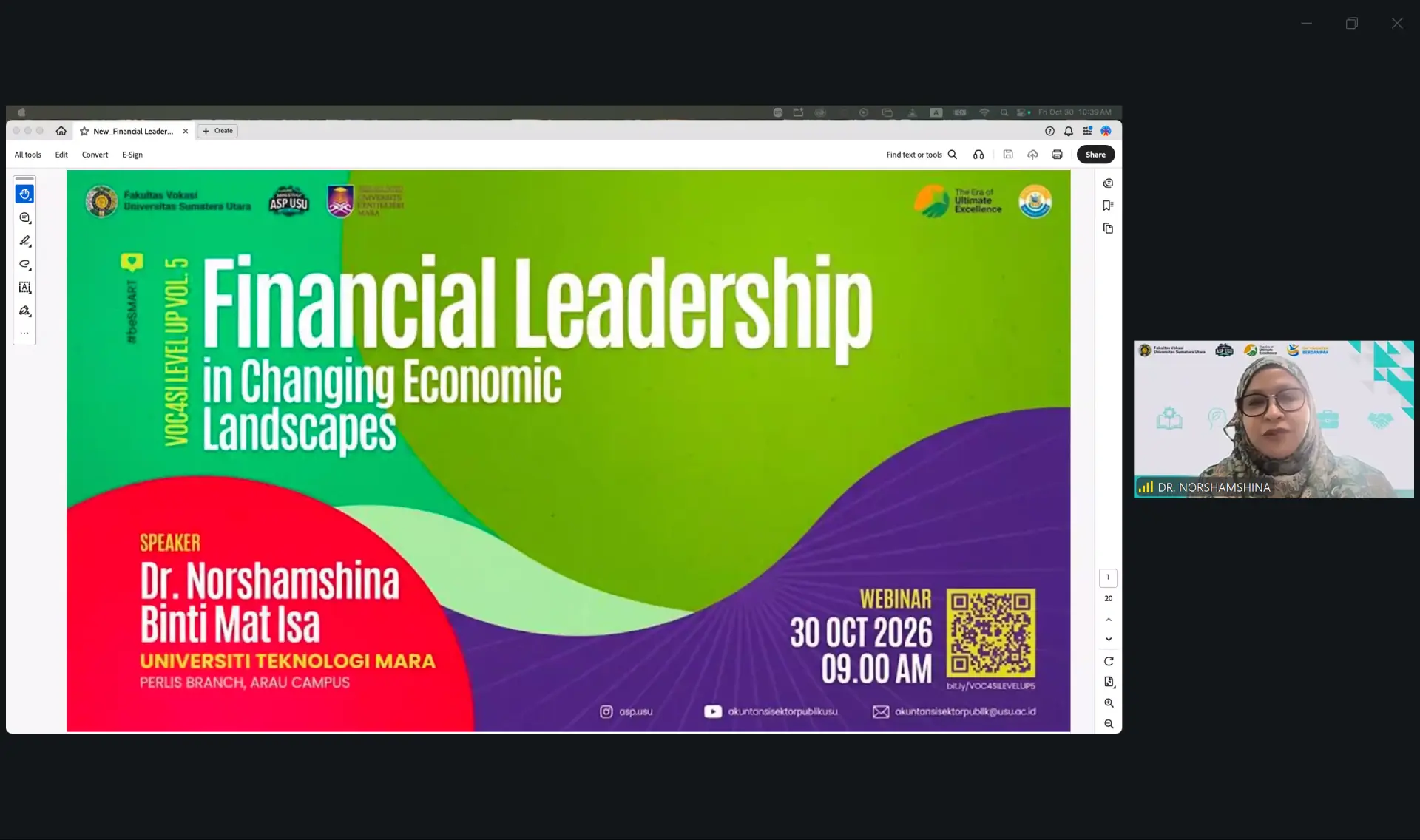
Zoom Meeting, October 29, 2026 — The Applied Bachelor’s Degree Program in Public Sector Accounting at the Faculty of Vocational Education Universitas Sumatera Utara, is once again conducting the VOC4SI Level Up Volume 5 Webinar with the theme “Public Financial Management and Value Added” and the discussion topic “Financial Leadership in Changing Economic Landscapes.” This online event features Dr. Norshamshina Mat Isa, a lecturer from the Department of Finance, Faculty of Business and Management, Universiti Teknologi MARA (UiTM), Malaysia, as the speaker.
This webinar discusses the importance of financial leadership in responding to changing economic conditions and organizational needs. In her presentation, Dr. Norshamshina explained that financial management should not only focus on compliance with budgets and expenditure controls but also aim at value creation, strategic decision-making, and the effective and sustainable use of resources.
One of the main discussions in the webinar is the limitations of static budgeting when the volume of organizational activities experiences significant changes. The fixed budgeting approach may become less responsive to changing operational needs. Therefore, organizations need to understand the application of flexible budgeting, which allows cost planning to be adjusted according to actual activity levels. This approach helps organizations evaluate budget needs more relevantly and improves accuracy in financial decision-making.
Furthermore, the resource person explained that budgeting has different characteristics and orientations in each type of organization. In the public sector, budgeting must consider the sustainability of public services, the legality of budget use, compliance with regulations, and accountability in resource management. The success of financial management in the public sector is not only measured by the efficiency of budget use but also by the benefits it provides to society. Meanwhile, in the private sector, budgeting is more directed towards operational efficiency, the ability to respond to market demands, achieving profitability, and business sustainability. Private sector organizations are required to have flexibility in allocating resources to take advantage of revenue opportunities and maintain financial performance amid changing economic conditions.
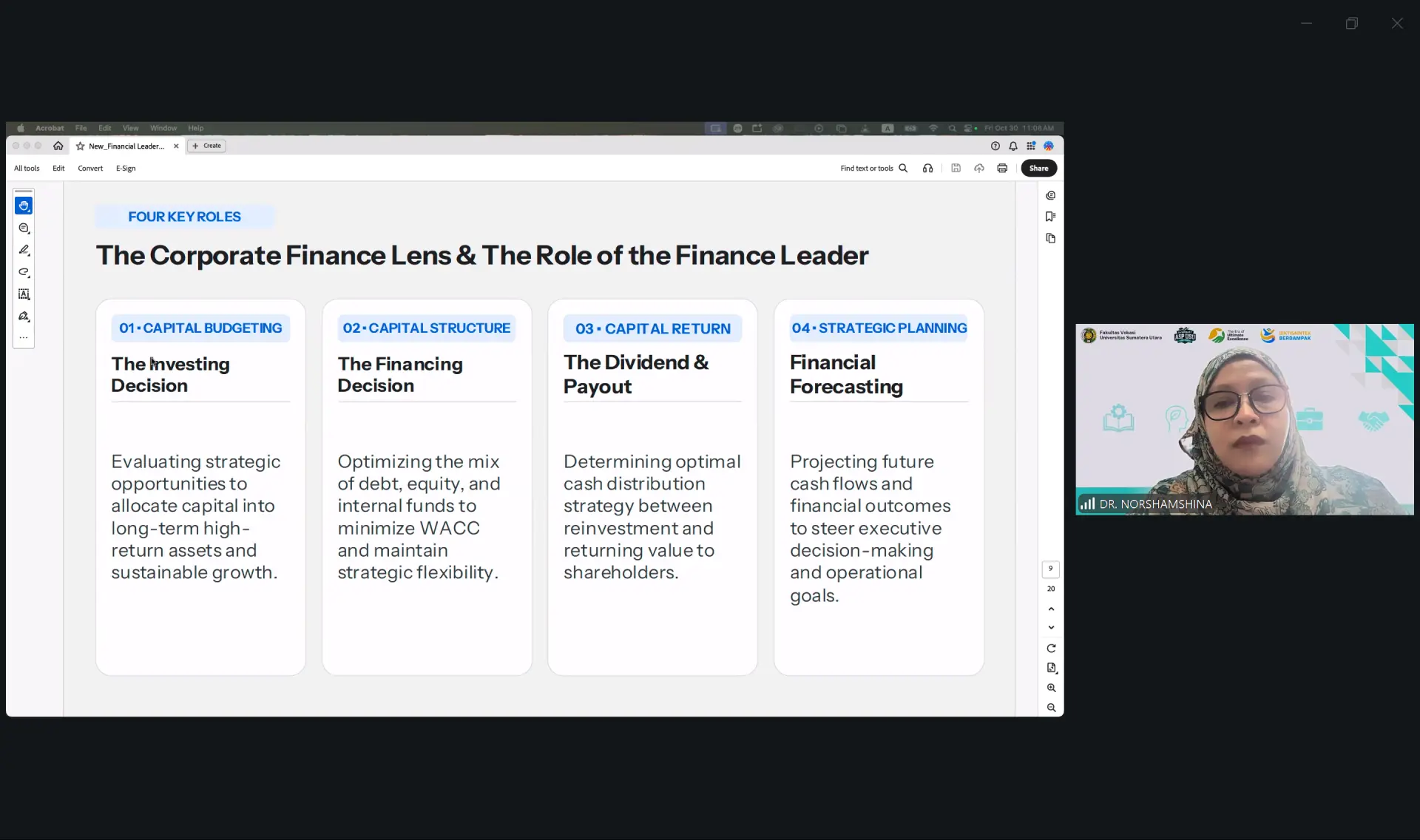
The discussion also encompasses the position of State-Owned Enterprises (SOEs), which have more complex characteristics. SOEs need to balance public interests with commercial viability. On one hand, SOEs have a responsibility to provide benefits to society, while on the other hand, they are still required to maintain operational efficiency and financial performance sustainability. This demonstrates that financial decision-making in SOEs requires considerations that can accommodate both interests.
Through this discussion, students gain the perspective that future accountants need to understand the characteristics of financial management in various types of organizations. Understanding the perspectives of the public and private sectors is an important foundation for prospective accountants to provide professional judgment, analyze budgeting needs, and support decision-making that aligns with the objectives and responsibilities of each organization.
The implementation of the VOC4SI Level Up Volume 5 Webinar is also a form of international cooperation between the Vocational Faculty of USU and Universiti Teknologi MARA (UiTM), Malaysia. The involvement of academics from UiTM provides students with the opportunity to gain financial insights from an international perspective while also broadening their understanding of financial management practices in diverse organizational environments.
Through this activity, the Applied Bachelor’s Degree Program in Public Sector Accounting hopes that students not only understand the technical aspects of budgeting and financial management but also develop a strategic, adaptive, and accountable mindset in facing the changing economic landscape and the challenges of the accounting profession in the future.