


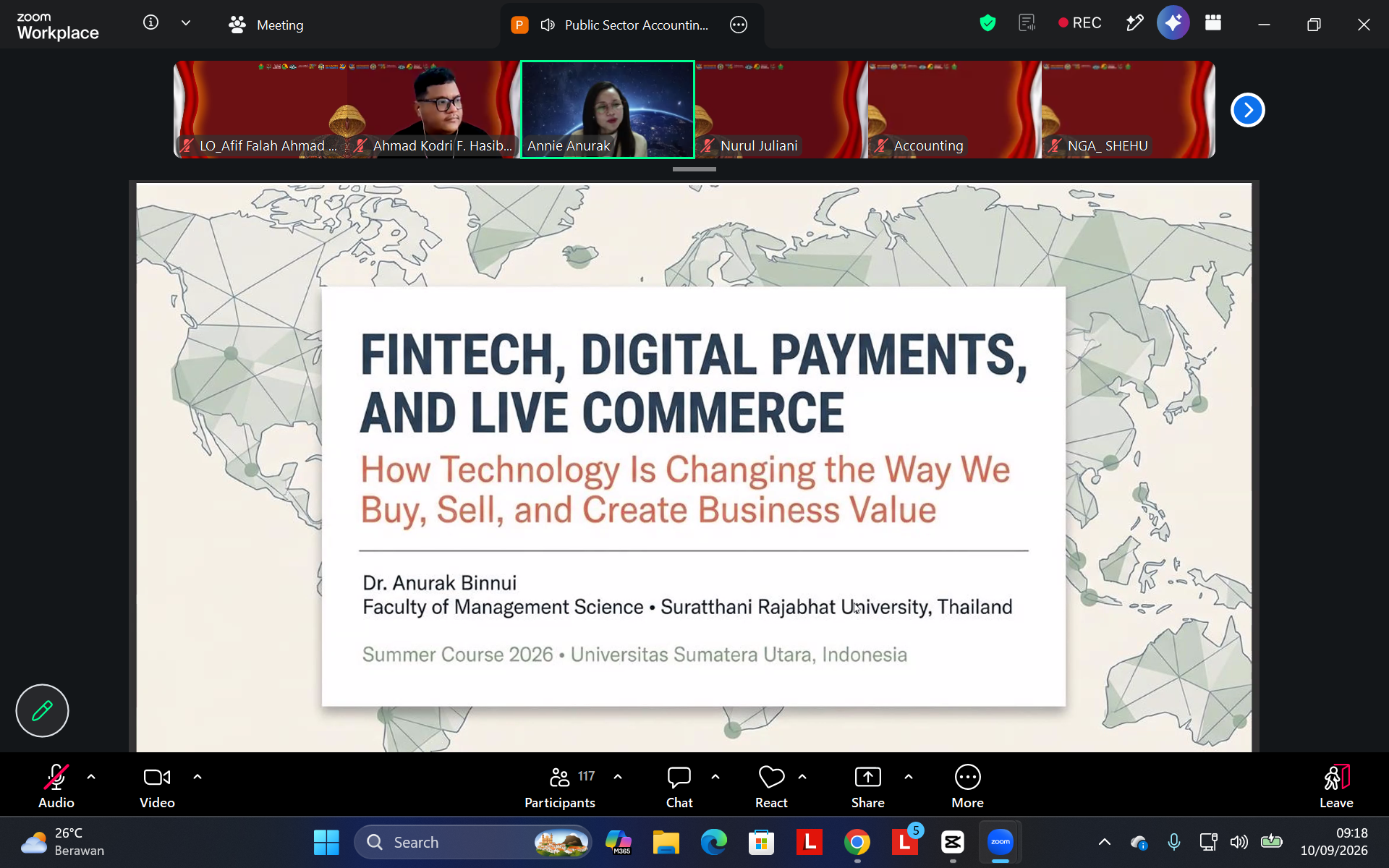
Medan, September 10, 2026 — The development of fintech, digital payments, and live commerce continues to change the way society conducts transactions while opening up various new opportunities to create business value. This perspective is part of the learning experience for Public Sector Accounting students of the Vocational Faculty at the Universitas Sumatera Utara (USU) in the International Summer Course 2026 titled "Future-Proofing Global Business and Accounting: Digital Innovation, Sustainable Finance, and Governance."
On the fourth day of the first session, students participated in a session themed "Fintech, Digital Payments, and Live Commerce: How Technology is Changing the Way We Buy, Sell, and Create Business Value," presented by Dr. Anurak Binnui from Suratthani Rajabhat University, Thailand. Through presentations and various interactive activities, students were invited to understand how technology can be utilized to create business value while supporting the decision-making process.
One of the key messages conveyed by Dr. Anurak is the importance of viewing AI as a coworker or teammate, not as a replacement for humans in the decision-making process.
“AI is your friend; AI is your teammate. They are not your boss.”
This message directs students to move beyond the question of whether AI will replace accountants and shift their perspective to how accountants can work alongside AI to produce better decisions. According to Dr. Anurak, AI has the capability to work quickly, be organized, and generate various analytical alternatives. However, the results provided by AI still need to be understood and evaluated by humans before being used as the basis for decision-making.
To provide a hands-on experience for the participants, Dr. Anurak presented a case study to the students. The participants were asked to input a prompt into the AI with business conditions including a 30% increase in sales, a 60% rise in marketing costs, a 40% increase in product returns, a 50% rise in customer complaints, and a 20% decrease in cash flow. The AI then generated several areas that needed attention, such as the unsustainable increase in marketing costs relative to sales growth, issues with product quality and customer experience, and potential problems with working capital management.
One of the participants from USU then read the AI's response to the prompt and shared her opinion. She assessed that the analysis provided by the AI was quite reasonable but emphasized that humans need to conduct further investigation to verify the accuracy of the information and determine the appropriate methods for decision-making.
In response to this opinion, Dr. Anurak appreciated the participant's understanding and stressed that the ability to use AI does not end with accepting the provided answers. Users need to read, comprehend, and re-question the information generated before using it as a basis for decision-making.
Thus, the ability to use AI is not only related to generating answers but also to the human ability to read, understand, question, and determine how the results will be applied.
The next session challenged students to develop business ideas by leveraging available technology. Dr. Anurak emphasized that there is not always one correct answer when developing business ideas. Students were encouraged to create concepts based on the resources, knowledge, and conditions they possess.
The discussion also raised the potential of community-based industries in Indonesia and Malaysia, including products derived from commodities such as rubber, cocoa, and other agricultural products. According to Dr. Anurak, resources already available in the community can be developed into various products and business models by utilizing digital technology.
Interestingly, students were also introduced to the opportunity of becoming business advisors. One does not always have to be the owner of a product or invest their own capital to be involved in the business world. Knowledge and the ability to provide advice to entrepreneurs can also be a valuable offering.
In the context of accounting students, this approach broadens the understanding that the ability to comprehend numbers does not stop at record-keeping and reporting. Students also need to understand what lies behind those numbers, how information is used, and how that information can help entrepreneurs make decisions.
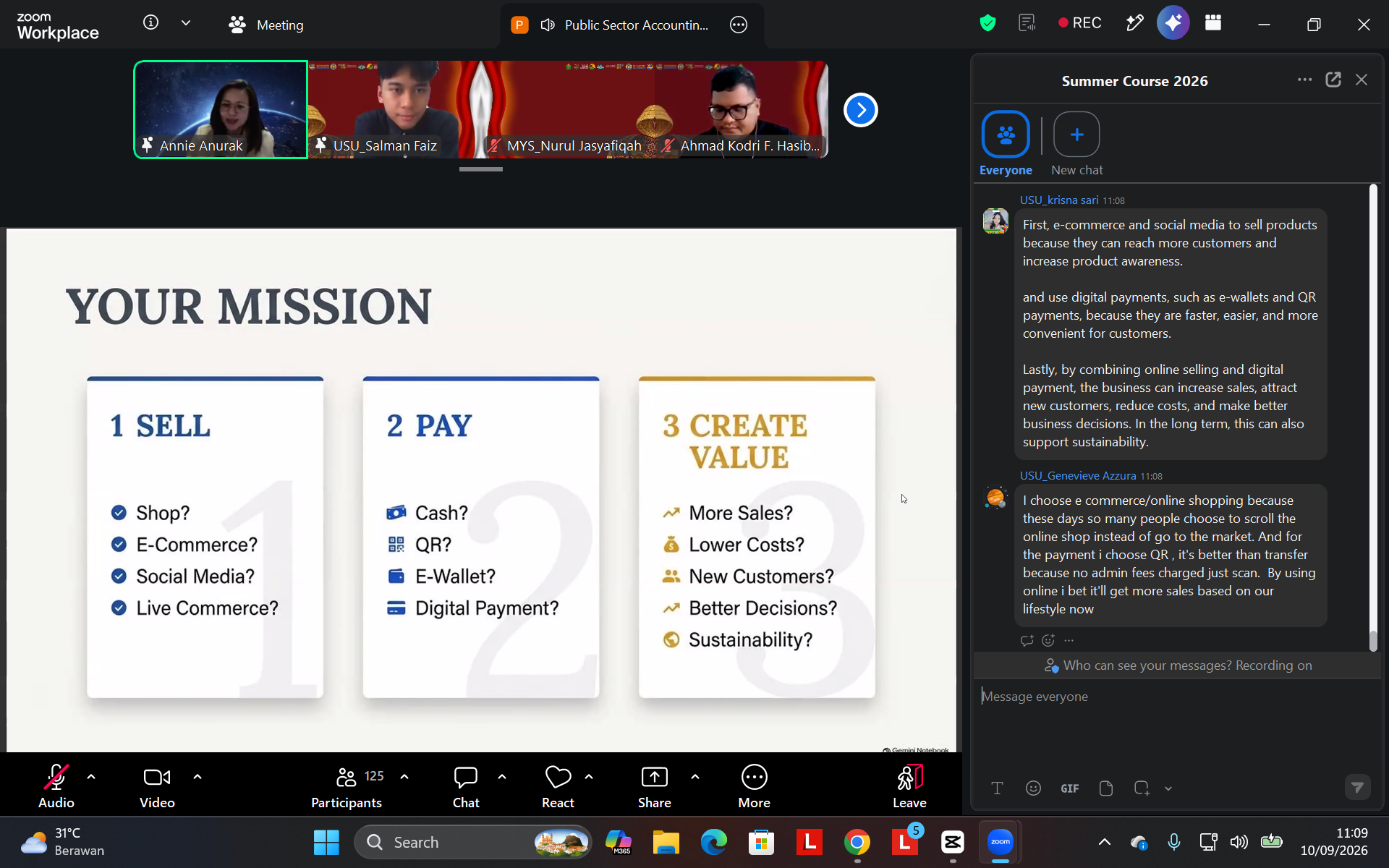
The discussion then evolved into the utilization of social media, digital payments, and live commerce in creating a faster and more interactive sales experience. Several students proposed using social media and live commerce to reach new customers, interact directly with consumers, and utilize QR codes and digital payments to facilitate transactions.
In response to these ideas, Dr. Anurak explained that live commerce allows promotional and sales activities to occur simultaneously. When sellers stream to introduce and demonstrate products, the back office can simultaneously handle orders and payment processes with technological support.
This model illustrates how technology not only changes the way consumers purchase products but can also transform the operational processes behind transactions. Orders can be recorded in real-time, payments confirmed, and products then processed and delivered to customers.
Students also proposed a subscription box model for special products. In response to the idea, Dr. Anurak pointed out that one doesn’t necessarily need to have their own product to build a business model. They can partner with entrepreneurs or communities that already have products, while they take on the role of developing the sales, marketing, and customer relations model.
In several activities, students also used AI to help develop and organize the ideas they presented. Dr. Anurak appreciated this use because AI can assist in structuring ideas so that they are more organized when presented.
However, she reiterated that AI cannot replace the willingness and initiative of humans to take the first step. According to her, students already have various technological tools at their disposal, but this technology will only provide benefits when used to turn ideas into action.
This message is relevant to the challenge given to students to not seek whether an idea is right or wrong, but rather how that idea can provide ease and value to others.
One interesting discussion arose when students asked about individuals with more introverted personalities who feel less confident about appearing on social media or live commerce.
Dr. Anurak emphasized that introverted traits do not hinder one from becoming a business actor. She stated that utilizing technology such as AI, AI video, or live streaming can be one alternative to help someone introduce a product without necessarily being the center of attention.
Nonetheless, she stressed that the product, quality, and customer trust remain important factors. Technology can aid in the communication process, but consumers still need assurance that the offered products truly have quality and provide value.
For students, the discussion shows that digital transformation is not only about transaction technology, but also about how technology is used to build relationships with consumers, convey product values, and create a more convenient experience.
The session delivered by Dr. Anurak provides a broader perspective for Public Sector Accounting students regarding the changing role of accountants amidst technological advancements. AI can help process and organize information, digital payments can simplify transactions, while live commerce and social media open new ways to reach consumers. However, all of these technologies still require humans who are able to understand context, question information, make decisions, and take responsibility for their use.
Through this session, students are not only invited to understand developments in fintech, digital payments, and live commerce but are also encouraged to see technology as a tool to enhance human abilities in creating value and making decisions. The message conveyed in this session aligns with the challenges for students in the digital era to not only be able to use technology but also to understand what lies behind the data, test information generated by AI, develop ideas, and turn technology into solutions that provide real benefits.