


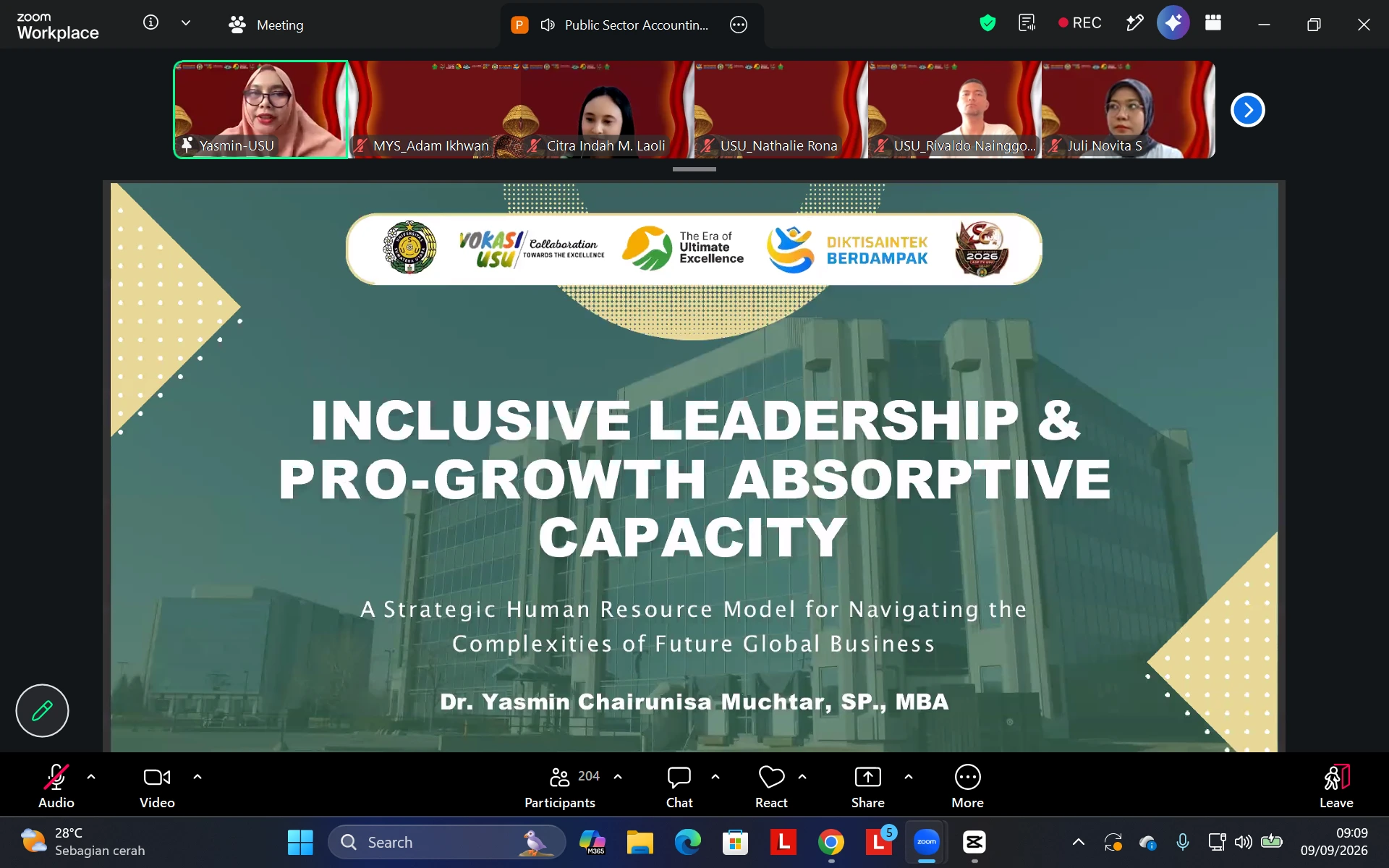
Medan, September 9, 2026 — Students of the Applied Bachelor's Degree Program in Public Sector Accounting at the Faculty of Vocational Education of Universitas Sumatera Utara (USU) are expanding their insights into human resource development strategies for facing the complexities of global business through the International Summer Course 2026. In a session titled "Inclusive Leadership and Pro-Growth Absorptive Capacity as A Strategy of Human Resource Model in Navigating Future Global Business", Dr. Yasmin Chairunisa Muchtar, SP., MBA, discussed the importance of inclusive leadership and organizational capacity to absorb knowledge as part of future human resource strategies.
In her opening remarks, Dr. Yasmin emphasized the importance of the topic amid the increasing complexity and rapid changes in the global business world. The discussion was directed to address the capabilities that organizations and leaders need to remain relevant and competitive in facing the future of global business.
Dr. Yasmin began by explaining the future business environment through the VUCA framework, which includes Volatility, Uncertainty, Complexity, and Ambiguity. These conditions illustrate rapid changes, uncertainty, interconnected factors, and situations that can present various possibilities in decision-making.
In such a scenario, organizations are required not only to adapt but also to possess the capacity to continuously learn, innovate, and grow. The material shows that human resource strategies need to shift from merely administrative functions to building capabilities and organizational knowledge architecture.
One of the main concepts introduced is Inclusive Leadership (IL), which is a leadership approach that involves organizational members regardless of gender, ethnicity, or background, and creates a safe space for employees to express ideas and opinions. This approach is considered to build trust, psychological safety, collaboration, and innovation within the organization.
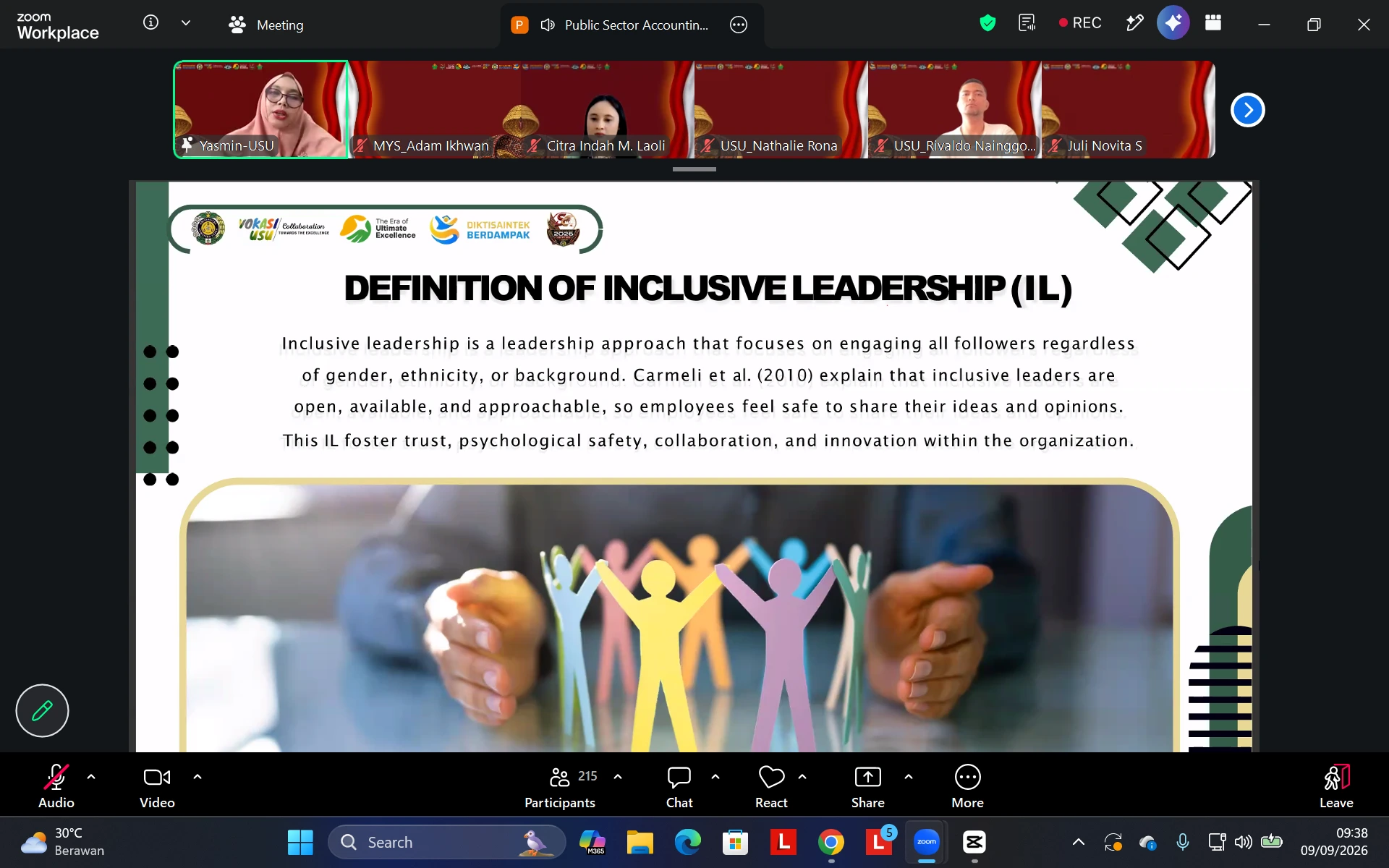
Dr. Yasmin explained three main characteristics of inclusive leaders, namely openness, availability, and accessibility. Leaders are expected to be open to different ideas and perspectives, willing to listen and provide support to organizational members, and easily reachable when employees need space to express issues or ideas.
This concept becomes increasingly relevant when organizations face the need to manage diverse perspectives. According to the material, cognitive diversity can be a source of innovation if leaders can create an environment that allows for various views to be articulated and considered constructively.
In addition to inclusive leadership, Dr. Yasmin introduced Pro-Growth Absorptive Capacity (PGAC) as the ability of individuals and organizations to acquire, understand, update, and utilize new knowledge to enhance value and performance.
In the context of organizations, PGAC encompasses the ability to continually discover constructive knowledge, update existing knowledge, and leverage the latest information and knowledge to achieve work objectives.
This ability is becoming increasingly important in the era of Society 5.0, where the development of artificial intelligence, the Internet of Things (IoT), big data, and automation demands that individuals continuously learn and adapt their competencies. The material also emphasizes that the knowledge acquired is not enough to be just collected; it needs to be applied to generate solutions relevant to human and societal needs.
In the discussion session, students questioned how leaders could still leverage diverse perspectives without slowing down decision-making when organizations face urgent situations.
In response to this question, Dr. Yasmin explained the importance of building cross-functional and cross-generational teams before a crisis occurs. By forming teams consisting of individuals from various generations and functions, the process of perspective exchange and decision-making can be practiced beforehand so that organizations do not have to start discussions from scratch when faced with situations requiring quick decisions.
Thus, diversity of perspective and execution speed do not have to be positioned as two opposing factors. Cognitive synergy is built before a crisis, while the established team structure serves as a foundation for responding to situations quickly.
Other discussions highlight how organizations can provide space for experimentation and the possibility of failure without sacrificing corporate performance targets. Dr. Yasmin connects this issue to the concept of the Agile Innovation Lab, which is an internal space that allows organizations to test new ideas before they are implemented on a larger scale. The material positions the Agile Innovation Lab as one element within Continuous Pro-Growth Absorptive Capacity to strengthen the organization’s ability to absorb, process, and apply new knowledge.
Through this approach, the experimentation process can be carried out in a measured space so that failures during the testing phase do not directly impact the core business. Dr. Yasmin emphasizes that organizations do not have to lower performance targets but need to differentiate between tolerable failures in the experimental process and unacceptable risks.
The issue of diversity is also discussed in the context of recruitment strategies. Students question how companies can avoid the tendency to recruit individuals based on cultural fit that could result in uniformity of thought.
Dr. Yasmin explains that recruitment strategies can be directed towards creating cognitive synergy through diversity, equity, and inclusion policies. The material highlights the importance of measurable policies in recruitment, promotion, and performance evaluation processes. Additionally, cross-functional and cross-generational collaboration models can be used to bring together individuals with different backgrounds, ages, and competencies.
According to her, organizations need to move from the tendency of “selecting for sameness” towards creating structured and constructive differences. In this process, inclusive leadership plays a crucial role in ensuring that diversity does not evolve into destructive conflict but becomes a source of learning and innovation.
The discussion then shifted towards the organization's ability to face external pressures that are beyond the company's control, including geopolitical turmoil. Dr. Yasmin emphasized the importance of planning, forecasting, and preparedness for various scenarios. Organizations need to develop the ability to anticipate changes, prepare alternative plans, maintain cash flow and reserves, as well as build teams that are ready to work collaboratively before a crisis occurs.
In this context, the ability to learn from experience and adapt becomes an essential part of organizational resilience. This aligns with the material that places pro-growth absorptive capacity as the ability to acquire new knowledge, apply it in innovation, and transform that innovation into sustainable growth.
To conclude her presentation, Dr. Yasmin offered an analogy that summarizes the relationship between the two main concepts in the material: “Inclusive leadership is the compass; pro-growth absorptive capacity is the engine. Together, they navigate the future of global business”.
Inclusive leadership acts as the compass that provides direction, values, and culture for the organization, while pro-growth absorptive capacity serves as the engine that drives the organization to constantly learn, grow, and innovate. Both need to work together so that the organization is not only able to move quickly but also has the right direction in facing the complexities of global business.
Through this session, Applied Bachelor's Degree Program in Public Sector Accounting students gained the perspective that readiness for the future of global business is determined not only by mastery of technology and technical knowledge but also by the ability to learn continuously, value diverse perspectives, collaborate, and build leadership that can create a safe and adaptive work environment.
Thus, the learning in the International Summer Course 2026 also broadens students’ perspectives on the importance of strategic human resource management as part of efforts to build an adaptive, innovative, and competitive organization in facing global changes.