


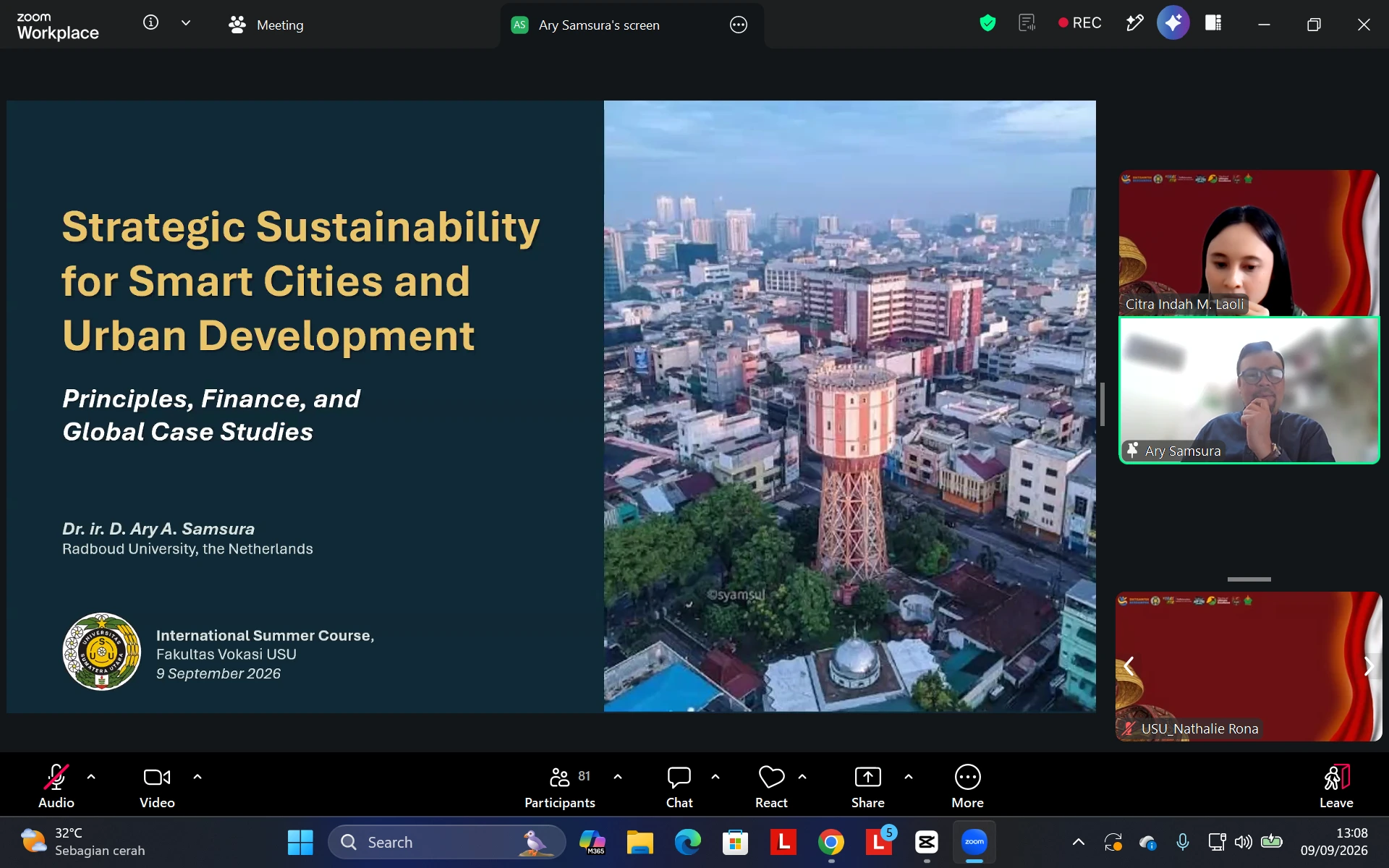
Medan, September 9, 2026 — Students of the Applied Bachelor's Degree Program in Public Sector Accounting at the Faculty of Vocational Education, Universitas Sumatera Utara (USU) are expanding their knowledge about global development challenges through the International Summer Course 2026 titled “Future-Proofing Global Business and Accounting: Digital Innovation, Sustainable Finance, and Governance.” During the session, students participated in a discussion themed “Strategic Sustainability for Smart Cities and Urban Industries,” presented by Dr. Ir. Datuk Ary Adriansyah Samsura.
The session raised a critical perspective on smart city development, which is not only focused on the application of technology but also needs to consider aspects of sustainability, justice, inclusivity, governance, and community interests. Through the material and discussions, students were invited to see that technology can be a supporting instrument for urban development, but it is not the sole measure of sustainable development success.
In his discussion, Dr. Ary emphasized that the concept of a smart city cannot be understood merely as the application of technology, data, artificial intelligence (AI), the Internet of Things (IoT), or automation. According to him, technology can indeed enhance a city's ability to provide services and manage various urban issues, but technology does not automatically make a city sustainable.
The material presented encourages participants to view urban development more comprehensively through the connections between land use, land rights, land value, actors, financing, and institutions. The Land-Tenure Nexus (LTN) framework introduced in the session is used as a lens to understand how various interests and components of urban development interact with each other.
The use of urban technology can also introduce new issues, such as the potential exclusion of certain groups or increased surveillance of the public. Therefore, the application of technology needs to be placed in the context of community needs and citizens' rights. These issues highlight that smart city development needs to look further than merely how advanced the technology used is. A sustainable city must also ensure that technological developments can align with public interests, justice, and benefits for the community.
One important idea discussed in the session is alignment, which refers to the effort to harmonize various interests and goals in urban development. Dr. Ary explained that there is no single form of alignment that can be considered a final condition or solution applicable to all situations. Urban development requires an ongoing adjustment process through learning, experimentation, evaluation, and adaptation.
This is important because various development goals, such as resilience, justice, and welfare, can be understood differently by each party. The government, community, businesses, and other groups affected by development may have different interests and perspectives.
Therefore, when government resources are limited and various issues cannot be resolved simultaneously, the approach needed is not solely to seek what is considered the most optimal solution, but to build a shared understanding and produce policies that can be accepted and implemented by various parties.
The discussion also emphasized the importance of community involvement in determining the direction of development. According to Dr. Ary, urban policies should be based on an understanding of the actual interests of the community, not merely assumptions from the policy-makers.
In the context of spatial planning, for example, community participation should not stop at the socialization activities after a plan is prepared. The community needs to be given space to express what they need and how development should be directed. This perspective shows that inclusivity is not only related to who is involved in the development process but also to the extent their views and needs are genuinely considered in decision-making.
Another issue that has gained attention is the impact of smart city development and green infrastructure on land values. The improvement in the quality of an area can increase land value, but at the same time, it also has the potential to drive gentrification, land speculation, and conflicts related to land rights, including customary land.
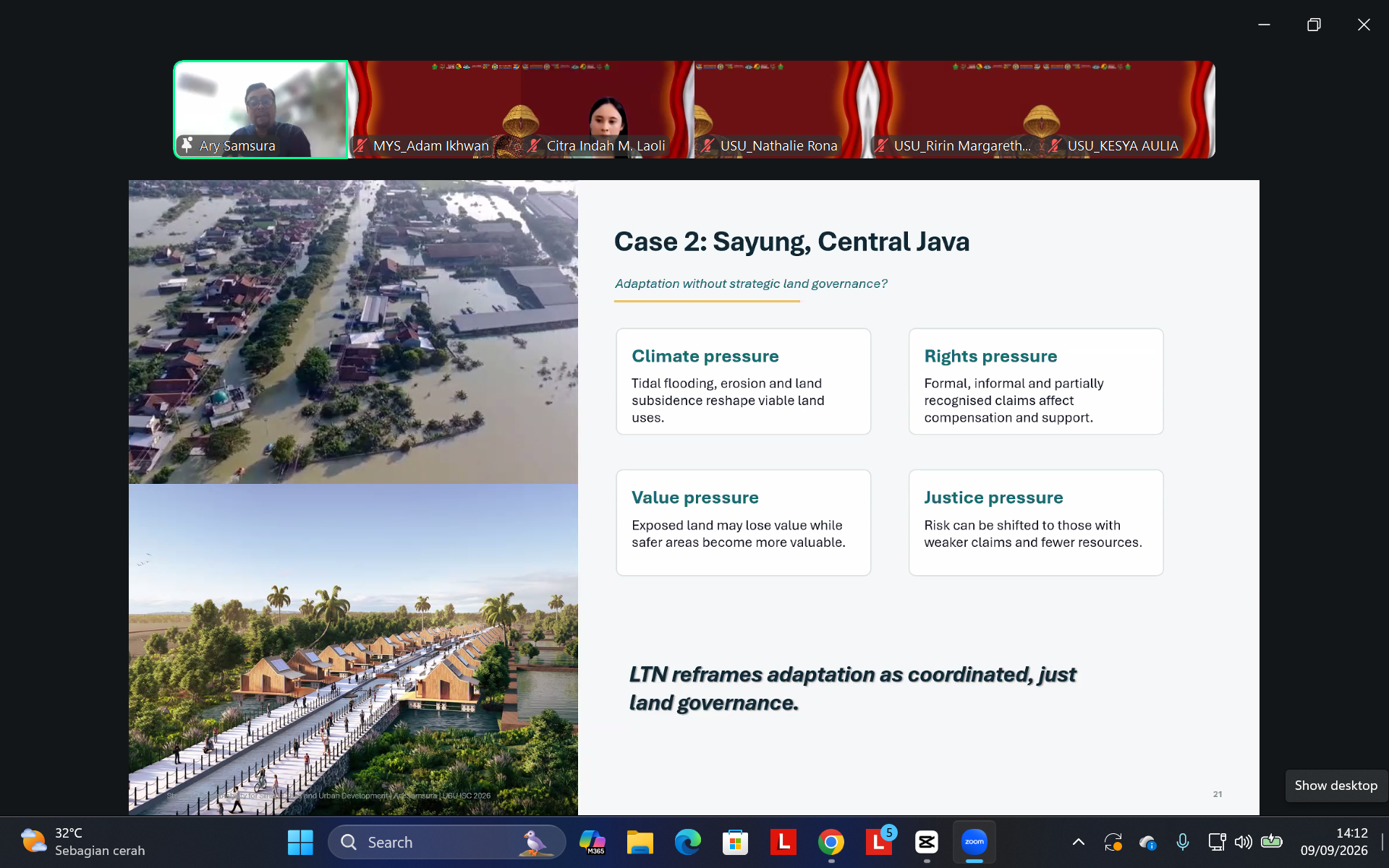
In this context, Dr. Ary introduced the importance of the land value capture approach, which is an effort to capture part of the increase in land value that arises as a result of development or public policy so that the benefits can return to support the community. This instrument can be implemented through various mechanisms, such as taxes, betterment levies, or specific development obligations. This idea demonstrates that urban development not only needs to create new economic value but also must consider how that value is distributed and who benefits from it.
The discussion on sustainability also includes the presence of industry, manufacturing, and logistics in urban areas. The issue that arises is not simply determining whether industrial areas should be maintained or relocated, but rather how to find a form of development that can accommodate the interests of the economy, society, the environment, and the sustainability of jobs.
In this context, it is again emphasized that there is no one-size-fits-all solution for all conditions. What is needed is a process of alignment that considers the characteristics of the region as well as the interests of various affected parties. This approach provides students with an understanding that urban sustainability is a multidimensional issue that requires coordination and governance across sectors.
The discussion also illustrates the close relationship between urban sustainability and the fields of accounting, finance, and governance. In his presentation, Dr. Ary explained that accounting makes value, obligations, risks, and accountability visible; finance allocates capital, risks, returns, and future obligations; while governance determines whose claims are counted, what values are captured, and how institutions adapt. This is relevant for students of the Applied Bachelor's Degree Program in Public Sector Accounting at the Faculty of Vocational Education, as urban development sustainability is related not only to planning and technology but also to how public value, financing, risks, and accountability are managed.
Ultimately, Dr. Ary emphasizes that "smart" does not always mean "sustainable." Technology and automation can help create smarter cities, but sustainability requires alignment among land use, land rights, land values, financing, actors, and institutions.
Through this session, Public Sector Accounting students gain an understanding that sustainable development requires a broader perspective, not only regarding how cities become smarter but also how such development can proceed in an inclusive, equitable, adaptive manner, and provide benefits for the community.