


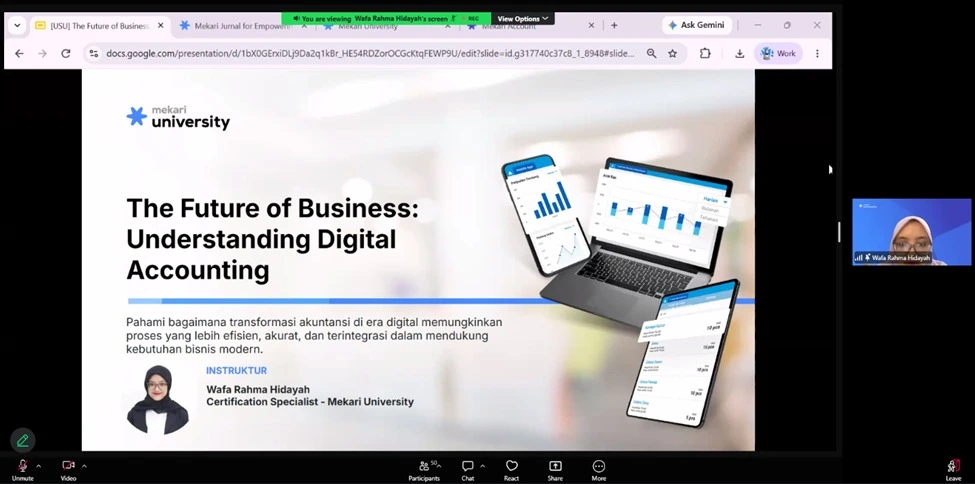
Zoom Meeting, October 22, 2026 — In facing technological advancements and digital transformation in the business world, understanding digital accounting systems has become one of the essential competencies for future accountants. To broaden students' insights into these developments, the Applied Bachelor's Degree Program in Public Sector Accounting, Faculty of Vocational Education, Universitas Sumatera Utara (USU), is holding a webinar titled “The Future of Business: Understanding Digital Accounting” online through Zoom Meeting. This event features the practitioner of the Public Accounting Information Systems course, Ms. Pristy Setyaningrum, S.E., and Ms. Wafa Rahma Hidayah, a Certification Specialist from Mekari, as the speakers.
In the opening remarks, the Head of the Study Program hopes that students can attentively participate in the activity, gain relevant knowledge related to the workforce needs, and complete the learning challenges presented. This opportunity is also expected to be the first step for students to recognize pathways for competency development and certification before completing their studies.
This webinar discusses the development of accounting in the modern business environment, particularly the transition from manual recording processes to faster, more accurate, and integrated digital systems. Through this session, students are introduced to the use of technology in accounting activities and its relevance to current workforce needs.
In her presentation, Wafa Rahma Hidayah explained that the development of accounting is not just related to changes in how financial data is recorded, but also to the use of technology to support business processes. Technology allows for financial information processing to be done more efficiently, accurately, and integrated with the company’s operational activities.
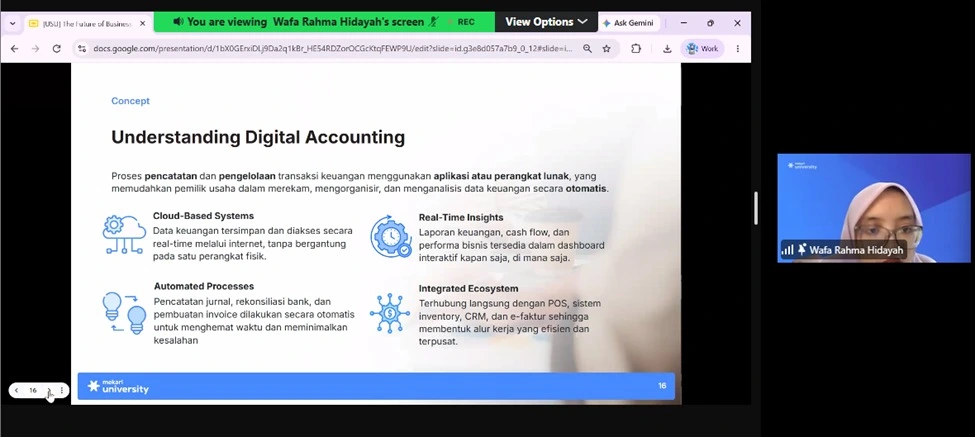
The concept of digital accounting is introduced as the process of recording and managing financial transactions using software. Its application is not merely about transferring records from books to computers, but also includes the use of cloud-based systems, process automation, real-time information access, and interconnected application ecosystems. These changes also impact the role of accountants. In addition to understanding financial recording and reporting, accountants need to be able to adapt to digital systems, understand the flow of information, and leverage data to support business decision-making.
One of the main topics discussed in the webinar is the role of Enterprise Resource Planning (ERP) as a crucial part of a company's digital transformation. ERP systems enable various business processes to be connected within one ecosystem, allowing organizations to avoid relying on numerous separate applications to manage their operational activities. Through this integration, data from various business functions can support more consistent recording and management of information. The use of integrated systems also helps reduce the risk of data discrepancies that can occur when recording is done manually or through unconnected systems. This discussion provides students with an understanding of how technology is used in professional activities. Understanding ERP and integrated accounting systems serves as a foundation for recognizing business processes that increasingly rely on digital technology.
This webinar also introduces Mekari as a provider of Software as a Service (SaaS) solutions that support business operations through cloud-based and integrated solutions. Additionally, students are introduced to Mekari Jurnal as one of the software tools that can be used to learn about digital accounting practices.
In the learning session, participants are directed to familiarize themselves with the use of the software through introductory material and demonstration videos of Mekari Jurnal. Participants also receive information about account access for learning and digital learning resources that can be utilized to deepen accounting competencies. This introduction is expected to help students connect the theory learned in lectures with the use of software relevant to professional activities. Thus, learning not only focuses on understanding concepts but also provides an initial overview of the application of technology in accounting work.
In addition to its benefits, digital transformation also presents challenges that need to be addressed. The use of digital systems requires technological readiness and the ability of human resources to adapt to changes in work processes. Students, as future professionals, need to continuously develop skills to keep up with the advancements in software and information systems used in the workplace. Data security aspects also become an important concern in the implementation of digital accounting. Company financial information is sensitive and confidential, so the use of technology must be accompanied by an understanding of data protection and information access management.
Through the webinar "The Future of Business: Understanding Digital Accounting," students are expected to gain a better understanding that the development of the accounting profession progresses alongside technological transformation. The ability to use digital systems, understand integrated business processes, and maintain information security becomes an essential part of preparing oneself to meet industry needs.