


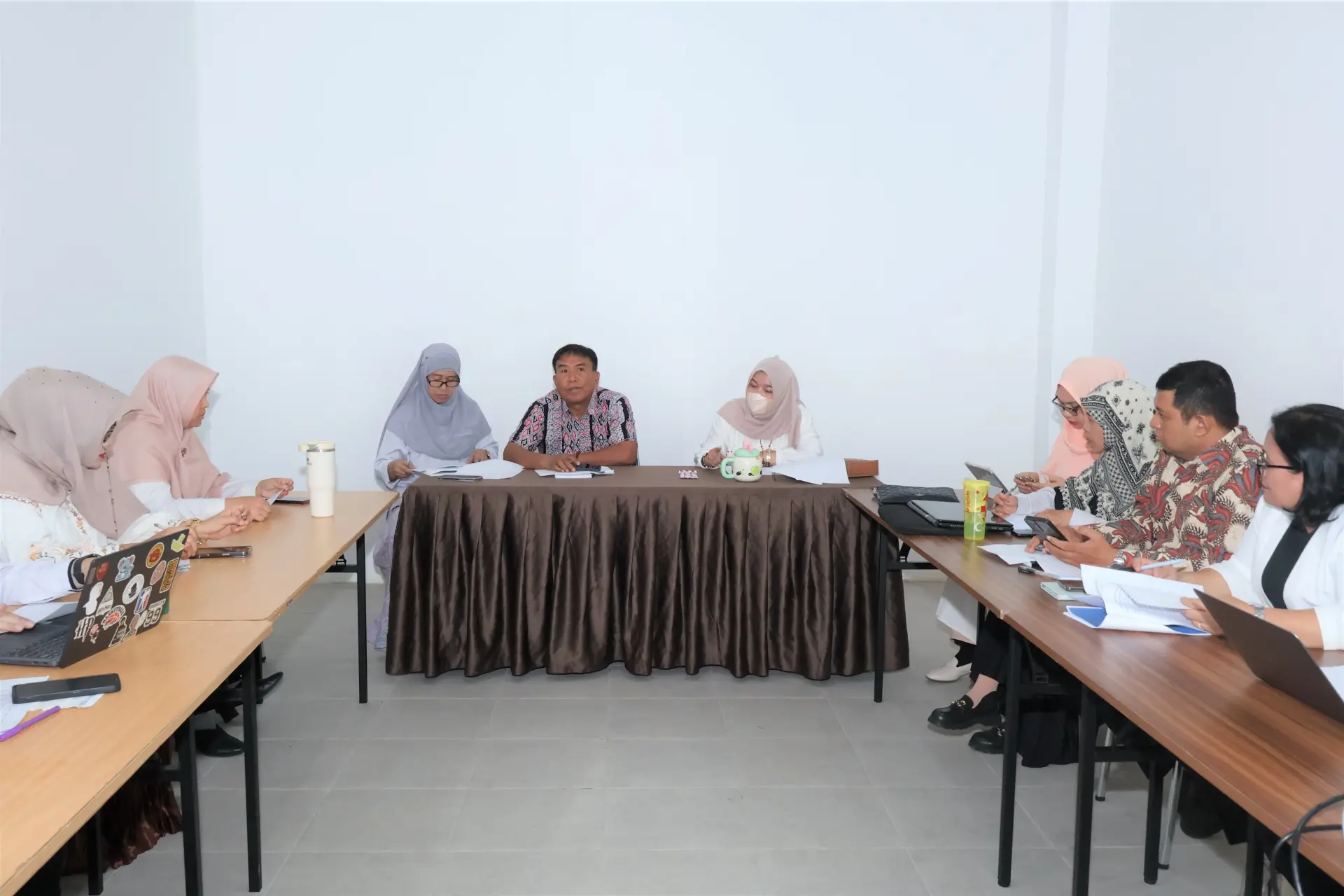
Medan, September 7, 2026 – The Faculty of Vocational Education at Universitas Sumatera Utara (USU) held a Research Master Plan (Rencana Induk Penelitian/RIP) Development Meeting for Study Programs as a strategic step to strengthen the direction and focus of research within the Faculty of Vocational Education. The meeting was held on Monday, September 7, 2026, at the Panel Room, Building A, Faculty of Vocational Education USU, and was attended by the Faculty’s deanery and heads of study programs.
The meeting was opened by the Vice Dean for Research, Community Service, Cooperation, and International Affairs, Junedi Ginting, S.Si., M.Si. In his opening remarks, he emphasized the importance of developing the Research Master Plan as a guideline for directing research activities to be more structured, relevant, and aligned with the development of academic disciplines and the graduate competencies of each study program.
The agenda continued with a discussion of the flagship research topics of each study program for the 2026–2030 period, led directly by the Dean of the Faculty of Vocational Education USU, Prof. Dr. Isfenti Sadalia, S.E., M.E. The discussion provided an opportunity to map the flagship research areas of each study program while ensuring strong alignment among research directions, academic developments, workforce needs, and graduate learning outcomes.
During the discussion, it was emphasized that faculty research within the Faculty of Vocational Education should refer to the Research Master Plan of each study program. Therefore, research activities would not be conducted independently, but would become part of an integrated research direction designed for the 2026–2030 period.
One of the key points in developing the Research Master Plan was the advancement of research outcomes into products or applications that can be utilized in real-world settings. The discussion highlighted that the development of an application should take no more than two years, making it important for research planning to realistically consider the stages of development, targeted outputs, and the sustainability of further development.
In addition to focusing on research outputs, the Research Master Plan is also designed to align with the graduate learning outcomes of each study program. Research directions are expected to support the competencies that graduates need to possess, thereby establishing a strong connection among faculty research activities, academic development, the learning process, and competency requirements in the workforce.
The discussion also raised the strategic question of what competencies faculty members are expected to develop and strengthen through research activities. This is an important component of mapping research directions, ensuring that research not only produces publications or academic outputs but also contributes to faculty competency development and the improvement of graduate quality.
Through the development of the Research Master Plan, the Faculty of Vocational Education USU seeks to establish a research direction that is more focused, integrated, applicable, and oriented toward future needs. The 2026–2030 Research Master Plan for each study program is expected to serve as a reference for faculty members in designing and conducting research that is strongly relevant to their respective academic fields while making a tangible contribution to the development of vocational education and society.
The activity also forms part of the Faculty of Vocational Education USU’s efforts to strengthen a research ecosystem capable of producing innovation and applicable solutions, while supporting the achievement of the Faculty’s vision as a vocational education institution that is adaptive to developments in science and technology and responsive to workforce needs.