


.webp)
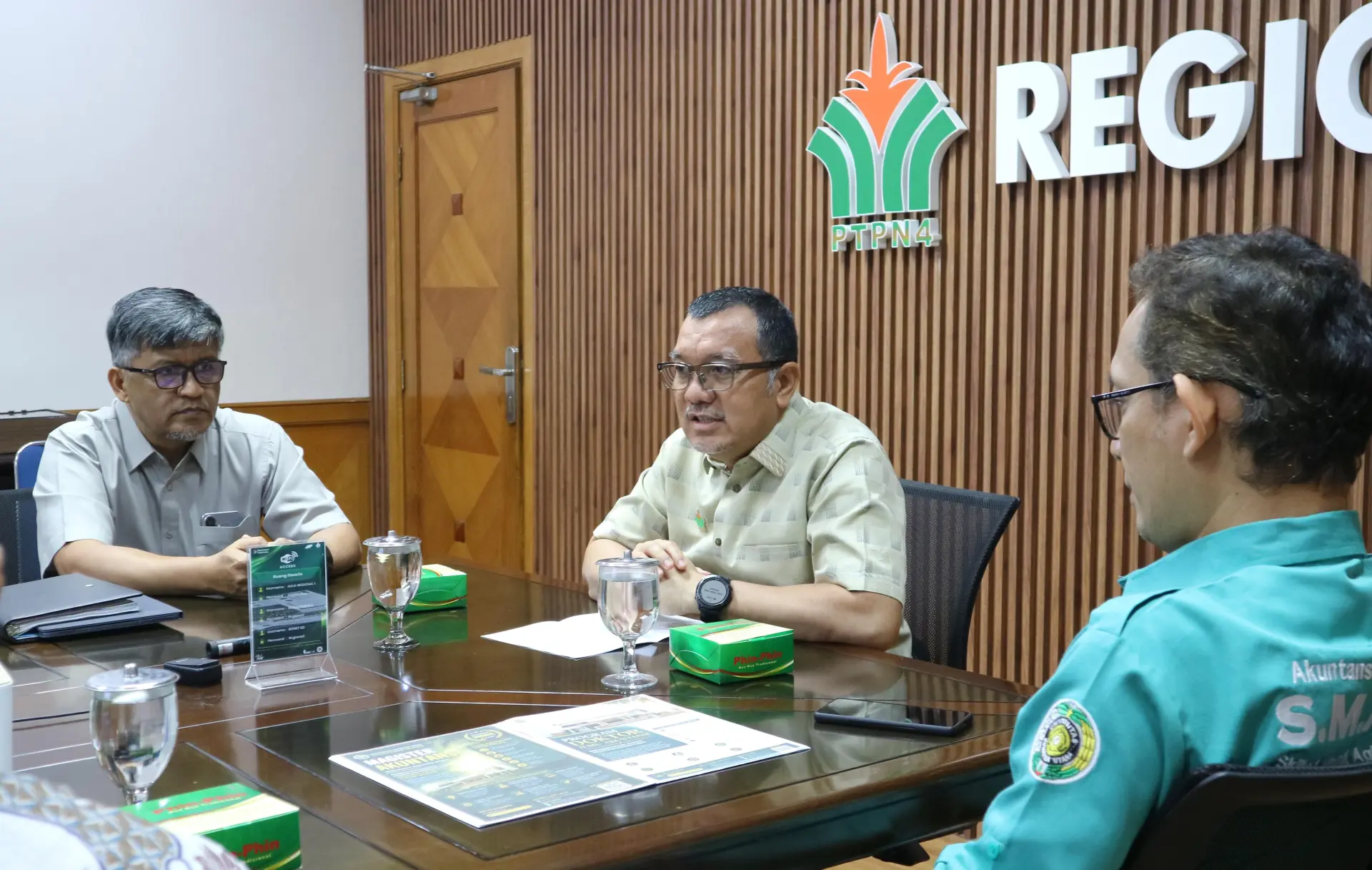
Medan, July 10, 2026 — The Faculty of Vocational Education at the Universitas Sumatera Utara, through its Applied Bachelor's Degree Program in Public Sector Accounting, continues to strengthen its collaboration with the industry through a meeting with PT Perkebunan Nusantara (PTPN) IV Regional I and Regional II. The meeting, attended by the Chair of the Applied Bachelor's Degree Program in Public Sector Accounting at the Faculty of Vocational Education, faculty members from the Applied Bachelor's Degree Program in Public Sector Accounting, and a delegation from the USU Faculty of Economics and Business, marked the first step in preparing for the implementation of the Practitioner-Faculty Program while aligning the curriculum with the needs of the increasingly digitized plantation industry.
Regional Head of PTPN IV Regional I, Rurianto, stated that digital transformation has fundamentally changed the company’s business processes, particularly in the areas of accounting and data management. Whereas data consolidation previously took five to seven business days, all transactions from the field are now digitized through the SAP ERP system and integrated into a single source of data.
In addition, PTPN IV has also developed the PalmCo Business Cockpit (PBC) as a management dashboard that enables real-time monitoring of company activities down to the plantation and block levels. This system accelerates analysis, supports decision-making, and ensures corporate accountability.
In response to this, Sambas Ade Kesuma, Chair of the Applied Bachelor's Degree Program in Public Sector Accounting at the USU Faculty of Vocational Education, explained that accounting education today is no longer focused solely on bookkeeping and the preparation of financial statements. Digital transformation has driven a shift in the role of accountants toward becoming analysts, system designers, and decision-makers. Nevertheless, core accounting competencies remain a foundation to ensure students can understand business processes and evaluate systems comprehensively.
“Accounting will not disappear due to digitization. What is changing is the nature of the work. Graduates must be prepared to operate at a more strategic level—capable of designing systems, managing information, and making decisions that add value to the organization,” Mr. Sambas further explained.
During the discussion, the USU Faculty of Vocational Education also presented its curriculum development, which is now oriented toward Outcome-Based Education (OBE). The focus of learning is no longer limited to producing outputs in the form of course completion, but rather on ensuring that graduates possess the competencies truly needed by the workforce.
Through collaboration with PTPN IV, the formulation of learning outcomes, Key Performance Indicators (KPIs), and even learning materials can be tailored to industry needs so that students are prepared to work in various sectors, not just in the plantation industry.
During the meeting, both parties also discussed various opportunities for further collaboration, ranging from the involvement of PTPN practitioners as guest lecturers, the development of a Plantation Industry Accounting curriculum, the organization of an International Summer Course, certification programs, problem-solving-based student internships, to the development of a Teaching Factory and applied research that supports the company’s digital transformation.
PTPN IV also encourages student interns not only to perform administrative tasks but also to evaluate business processes, identify opportunities for system efficiency, and provide recommendations for innovations that the company can implement. According to PTPN, collaboration between universities and industry is expected to produce tangible solutions while enhancing the competitiveness of human resources in Indonesia.
As a symbol of strengthening institutional ties, the event concluded with the exchange of commemorative gifts between the USU Faculty of Vocational Education and PTPN IV Regional I and Regional II. Through ongoing synergy with the industrial sector, the program hopes to provide a more contextual learning experience so that students not only master theory but also possess competencies, a mindset, and adaptive skills aligned with technological advancements and the needs of the plantation industry.