


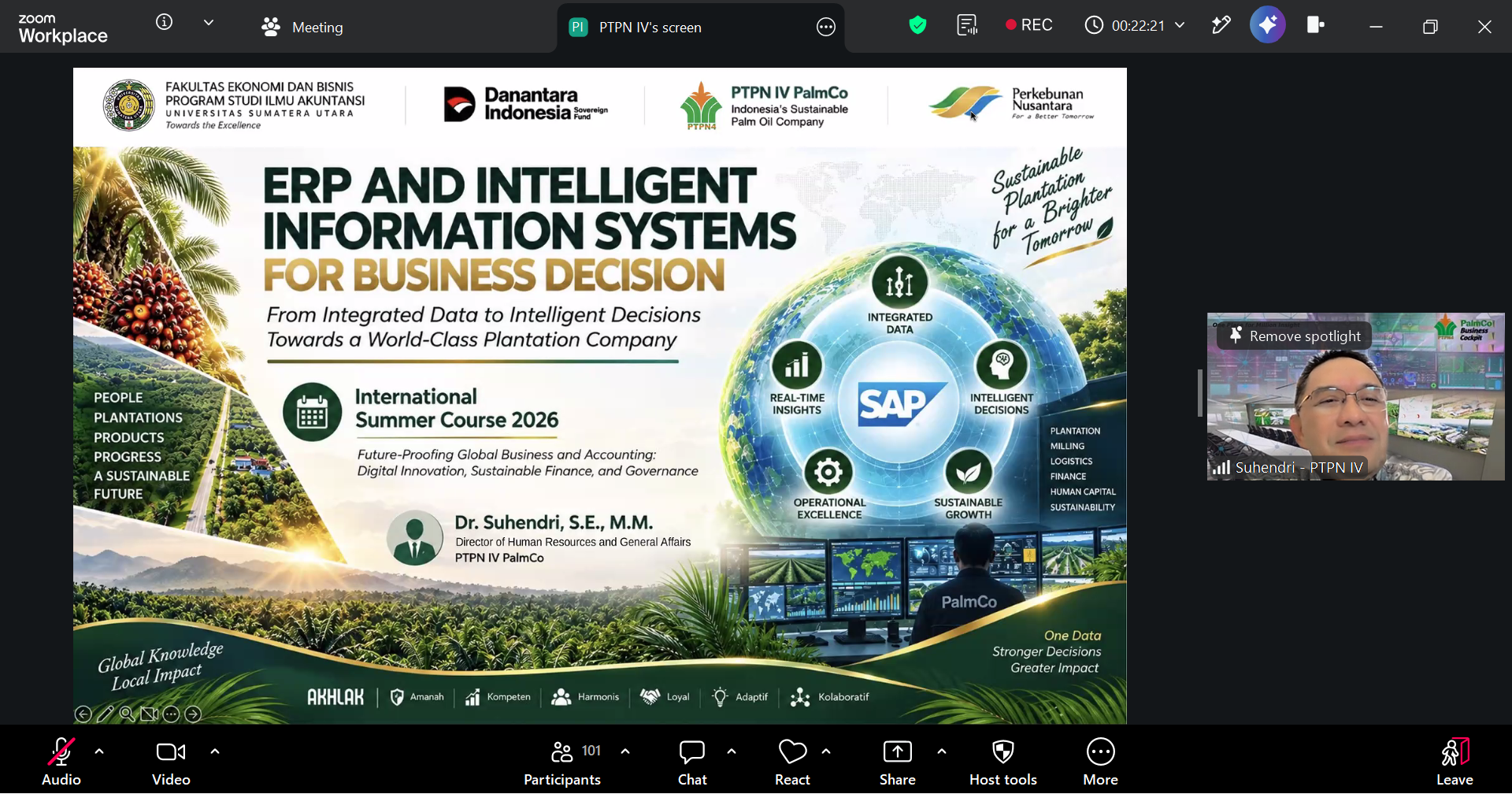
Medan, September 10, 2026 — Students from the Applied Bachelor's Degree Program in Public Sector Accounting at the Faculty of Vocational Education, Universitas Sumatera Utara, participated in the series of the International Summer Course 2026. Participants attended a session themed “ERP and Intelligent Information Systems for Business Decision: from Integrated Data to Intelligent Decisions Towards a World-Class Plantation Company” with Dr. Suhendri, S.E., M.M., Director of Human Resources and Information Technology at PTPN IV PalmCo, as the speaker.
This session provided insights into how the implementation of Enterprise Resource Planning (ERP) and Intelligent Information Systems can transform the utilization of data from transaction recording to information that supports understanding of business conditions, analysis, and accurate decision-making.
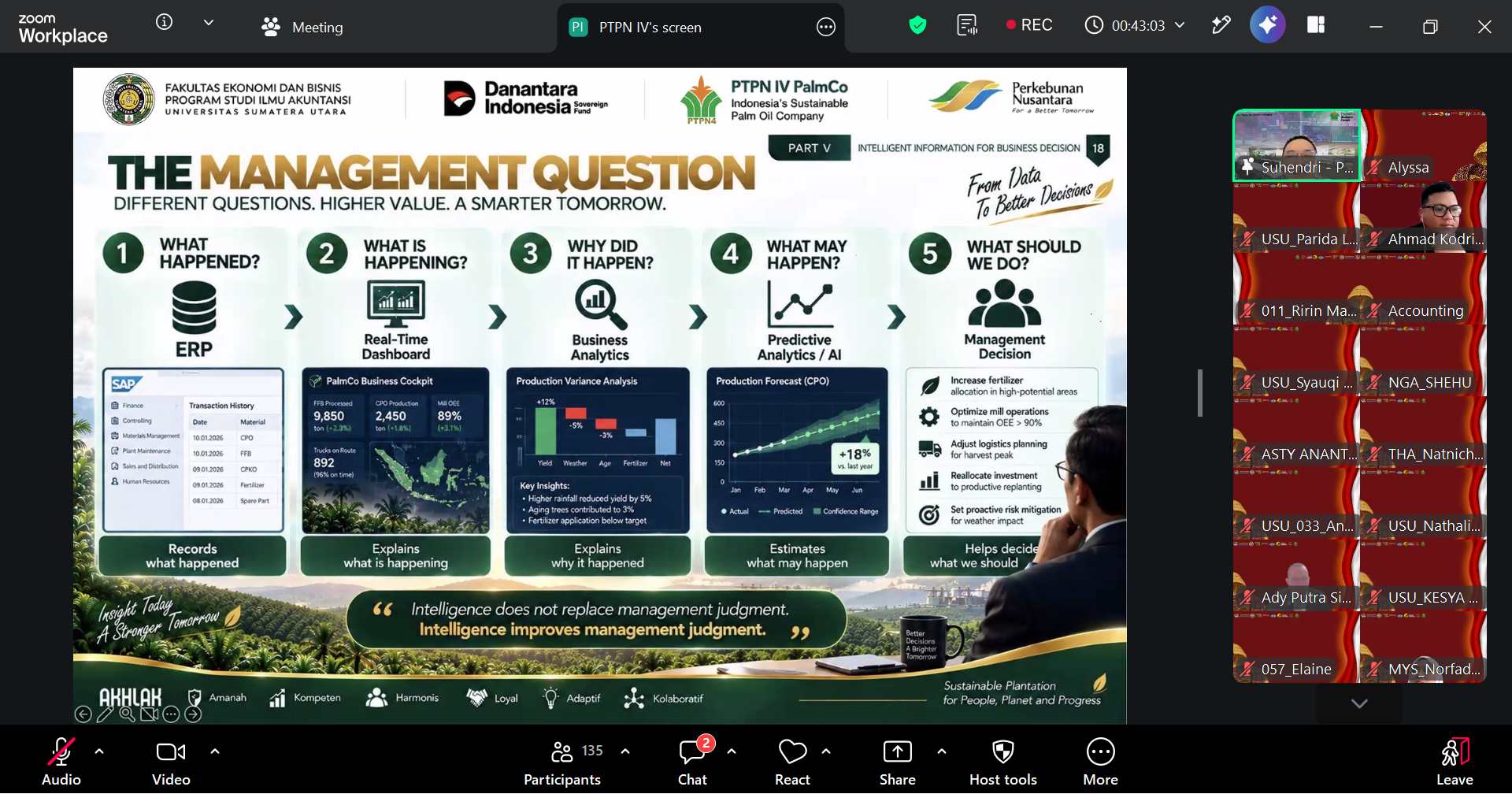
In his presentation, Dr. Suhendri explained that ERP fundamentally plays a role in integrating various business processes and transactions. However, the strategic value of the system does not stop at the ability to record what has happened. In the context of a plantation company with operational activities spread across various locations, the main challenge lies in how the data entering the system reflects the actual conditions on the ground. Discrepancies can occur when an activity has taken place, but the transaction has not been recorded or is recorded incorrectly according to the actual conditions.
This indicates that digital transformation is not only related to the use of systems but also to the accuracy, completeness, and timeliness of data. ERP can help answer what has happened, while dashboards and more intelligent information systems can assist in understanding ongoing conditions, analyzing causes, and providing an overview of possible future scenarios. Thus, the development of information systems shifts the decision-making process from merely recording the past to integrating information, understanding, and supporting decisions to face current and future conditions.
The discussion also expands participants' understanding of the utilization of ERP in human resource management. In organizations with a large workforce and dispersed operational locations, an integrated system is needed not only to know the number of employees but also to understand who is working, where they are working, how the work is done, and how that performance can be developed.
In the operational activities of plantations, attendance data and worker activities in the field can be linked to information about the work being done. This integration allows companies to obtain a more comprehensive picture of the relationship between the workforce, operational activities, and productivity.
The use of ERP can also help identify competency needs and skill gaps. If a position requires specific competencies while there are still gaps in the workforce performing that function, the integrated information can serve as a basis for the company to determine training and development needs.
This perspective positions technology not merely as an administrative tool but as a means to support the development of human capabilities and the enhancement of organizational productivity.
The subsequent discussion highlights that the biggest challenge in ERP implementation is not solely on the technology aspect. The success of the system also heavily depends on the integration between people, business processes, and data quality.
The system can process transactions automatically, but the information output still depends on how users carry out the processes and input data. If activities in the field have occurred but transactions are recorded late, using incorrect cost centers, or not in accordance with work orders, the system can still process that data, but the information produced may not accurately reflect the actual conditions.
This situation becomes increasingly important for companies with extensive and geographically dispersed operational activities. Therefore, a shared understanding of processes, discipline in executing procedures, and awareness of the importance of data quality among system users are needed.
In this context, technology serves as a tool, while people still play a crucial role in designing processes, inputting and validating data, understanding information, and making decisions based on that information.
The presentation session was followed by a discussion and Q&A with the participants. In this session, Mr. Ady Putra Sinambela, as the Subject Matter Expert of the PTPN Group, provided responses to participants' questions and continued the discussion from a company's practical perspective. This was done because Dr. Suhendri, S.E., M.M. had to attend a meeting.
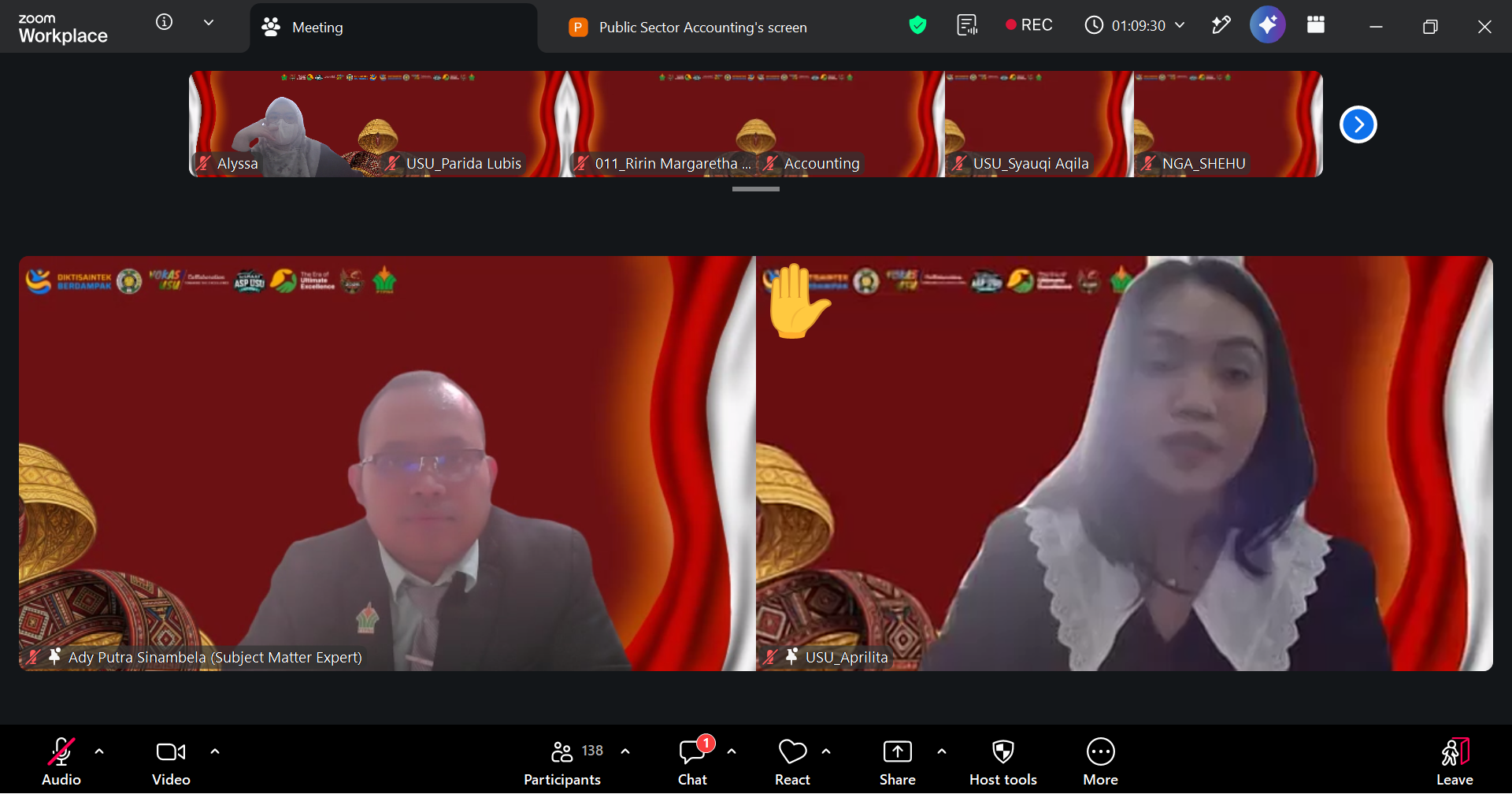
The discussion provided an opportunity for participants to see more concretely how ERP concepts and intelligent information systems are applied in the business environment. One of the discussions emphasized the difference between systems that function to record transactions and those that can process data into information to support decision-making.
Participants also gained insight that the quality of decisions is heavily influenced by the quality of available information. Integrated data needs to originate from well-functioning business processes, be recorded accurately, and be available at the right time to be beneficial for management.
The involvement of students from the Applied Bachelor's Degree Program in Public Sector Accounting in this session broadened their understanding of the evolving role of accounting amidst digital transformation. Accounting is no longer just about recording and reporting processes but also relates to how business data is integrated, analyzed, and used as the basis for decision-making.
Understanding ERP and Intelligent Information Systems has become relevant for students because these systems bring together aspects of accounting, information technology, business processes, human resources, and decision-making within a single ecosystem.
Through this session, students gained the perspective that the success of digital transformation is not only determined by the sophistication of the systems used but also by human readiness, process discipline, and the organization's ability to generate and utilize quality information.
This activity also strengthens the goals of the International Summer Course 2026 in providing learning experiences that connect academic knowledge with industry practices, particularly in facing technological developments and business competency needs in the digital era.