


Medan, September 8, 2026 — Students from the Applied Bachelor's Degree Program in Public Sector Accounting at the Faculty of Vocational Education of the Universitas Sumatera Utara (USU) gained insights into the development of regulations and crypto asset taxation through the International Summer Course 2026 in the session "Navigating Crypto Taxation 2026" with Mr. Zulfikar Azhar as the speaker.
This session provided a learning space for students to understand how the development of crypto assets and blockchain technology brings new challenges for tax authorities. The material discussed not only the mechanisms of crypto asset taxation in Indonesia but also invited participants to view the issues from the perspectives of global regulation, financial privacy, and digital economic competitiveness.
In his presentation, Mr. Zulfikar Azhar explained that the crypto asset ecosystem has characteristics that differ from conventional economic transactions. Blockchain-based transactions can occur through a globally distributed network, thus not always having a clear geographical boundary.
The presentation material explained that this borderless nature poses challenges in determining the location of taxation. Transaction structures that utilize foreign entities and decentralized platforms can complicate the process of matching transactions with taxpayer jurisdictions. Additionally, the pseudonymous nature of crypto wallet addresses also presents challenges because transaction history can be seen on the blockchain, but linking those addresses to their actual owners is not always easy.
These issues were then related to the development of global transparency standards. The material introduced the Crypto-Asset Reporting Framework (CARF) designed to support the automatic exchange of crypto asset data between countries. The implementation of this standard is one of the efforts to strengthen transparency and reduce the risk of tax avoidance through cross-border transactions.
The discussion also shows that each country can have a different approach to treating cryptocurrency for tax purposes. In the material, Indonesia is mentioned as classifying cryptocurrency as digital financial assets treated equally to securities. Meanwhile, the United States treats it as property, while several other countries have differing tax approaches according to the nature of transactions and their respective policies.
These differences also emerged in the discussion session when a student from Malaysia shared perspectives on the tax treatment of cryptocurrency in his country. He explained that tax treatment can consider the nature of the transaction and the taxpayer's activities. Cryptocurrency that is purchased and held as an investment may receive different treatment compared to repetitive buying and selling activities conducted as trading.
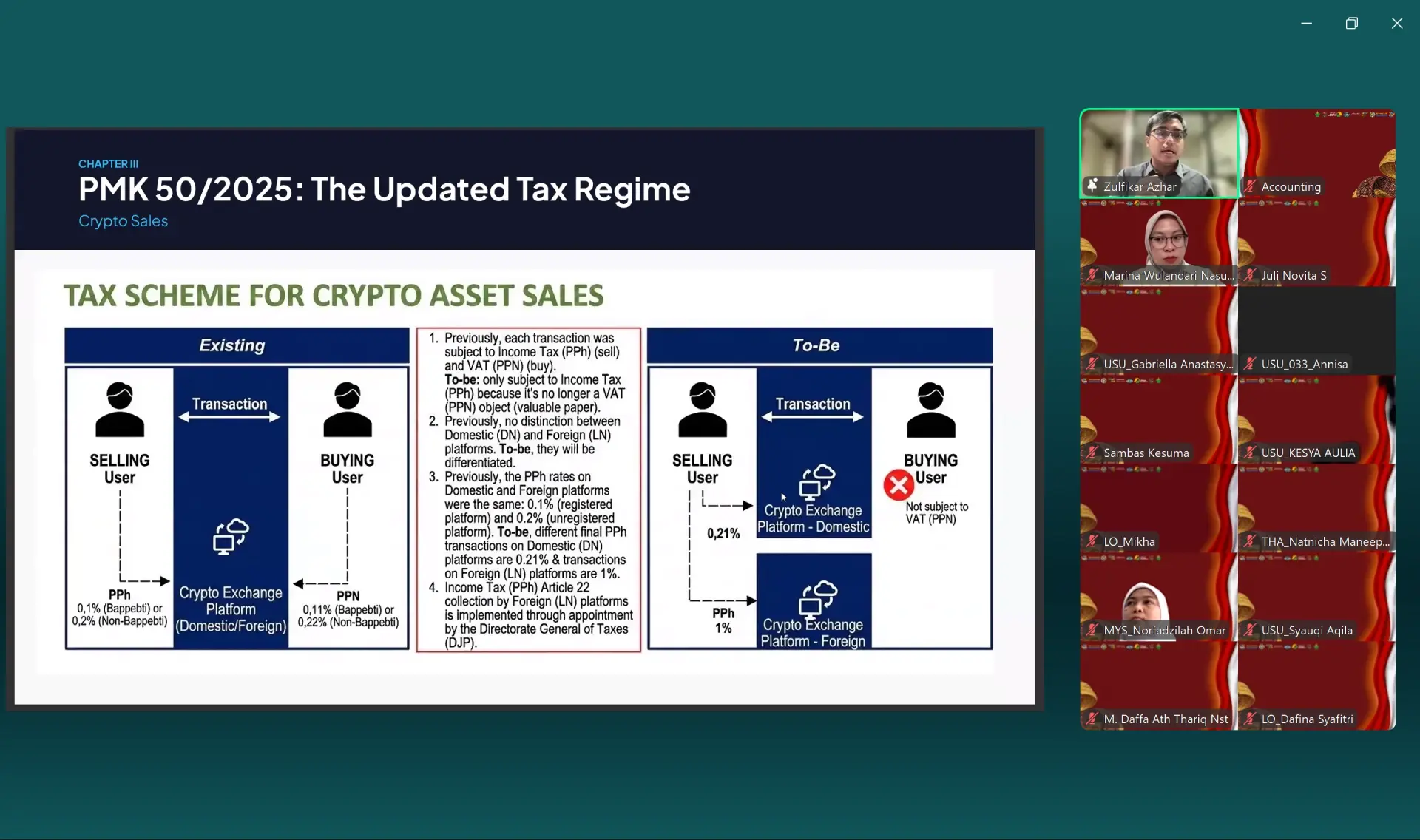
In response to this, Mr. Zulfikar explained that Indonesia's approach utilizes a final income tax mechanism on the sale of cryptocurrency assets, so the imposition of tax is not based on the calculation of individual gains or losses from each transaction, as in the capital gains approach. According to him, this approach is a simpler choice in the context of a cryptocurrency ecosystem that is still developing.
The material also explains that based on PMK 50/2025, the sale of cryptocurrency assets and services related to that ecosystem receive different tax treatments. Cryptocurrency is treated as securities, so transactions involving these assets are not subject to VAT, while services provided by exchange platforms and certain activities within the cryptocurrency ecosystem still have their own VAT treatment.
One interesting discussion in the session was the relationship between the right to financial privacy and the state's need to ensure tax compliance. Mr. Zulfikar encouraged participants to consider the boundaries that need to be set between individual privacy protection and public interest. According to the perspective presented in the session, regulators do not need to know every individual transaction in detail, but they do need to have mechanisms that allow authorities to ensure tax obligations are met.
In answering students' questions, he presented three approaches: regulating choke points where crypto assets meet the real economy, applying proportional thresholds based on materiality, and utilizing compliance technology that still considers privacy.
For example, the choke points approach can be directed at exchanges or trading platforms that serve as the meeting points between the crypto ecosystem and the conventional financial system. Meanwhile, reporting thresholds can be used to distinguish ordinary transactions from those with specific materiality.
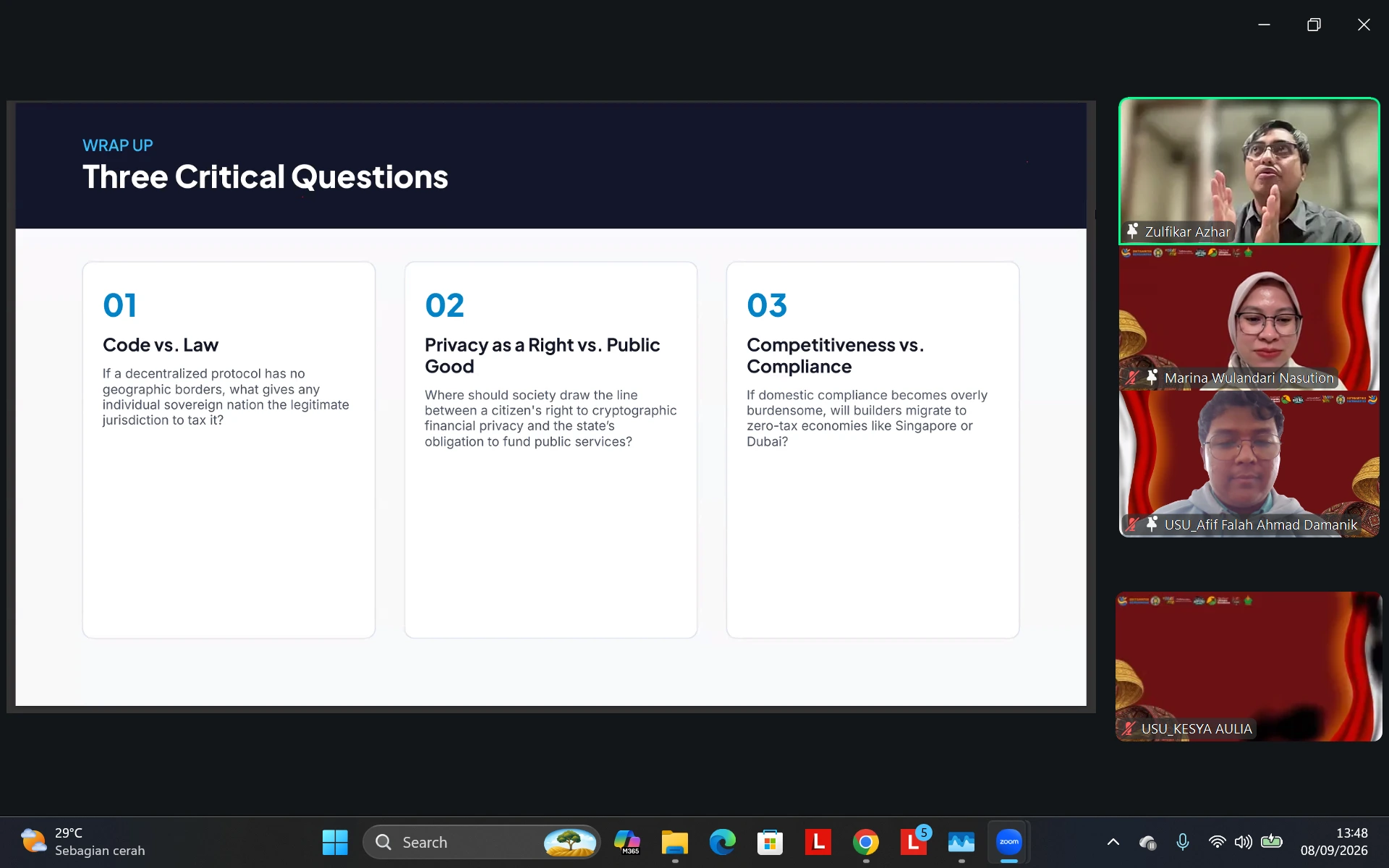
In addition to tax issues, the discussion also highlighted the challenges governments face in maintaining a balance between fiscal integrity and the competitiveness of the digital innovation ecosystem. Mr. Zulfikar raised the question of how Indonesia can formulate policies that ensure compliance without driving innovators or capital to relocate to other countries that offer more competitive tax environments. The material also framed this issue as one of the main dilemmas in cryptocurrency regulation: overly burdensome compliance rules could reduce the competitiveness of domestic platforms and drive activities towards foreign jurisdictions.
The issue becomes even more complex because cryptocurrencies are not only related to buying and selling activities but also thrive within the Decentralized Finance (DeFi) ecosystem, such as staking, lending, decentralized exchanges, and yield farming. The characteristics of DeFi, which are intermediary-minimal, decentralized, and use complex transaction structures, pose unique challenges for conventional tax systems.
The discussion then evolved into an interactive dialogue that brought together students' perspectives from various countries. The questions that arose were not only related to the mechanisms of tax imposition but also touched on aspects of regulation, risk oversight, asset classification, compliance, and the differences in tax approaches between countries.
Three critical questions posed by the speakers at the end of the presentation became one of the main parts of the session, namely "Code vs. Law," "Privacy as a Right vs. Public Good," and "Competitiveness vs. Compliance". All three encouraged students to see that the development of crypto assets is not merely a matter of technology or taxation but also relates to state authority, public interests, and the direction of digital economic policies.
Through the session, public sector accounting students not only gained an understanding of how cryptocurrency is treated within the Indonesian tax system, but were also encouraged to comprehend why a tax policy is formulated, the challenges faced by regulators, and how this policy compares to approaches taken by other countries.
This learning reinforces students' perspectives that developments in digital technology require future public sector accountants to not only understand tax calculations and regulations but also to see the connections between technology, fiscal policy, governance, and public interests.